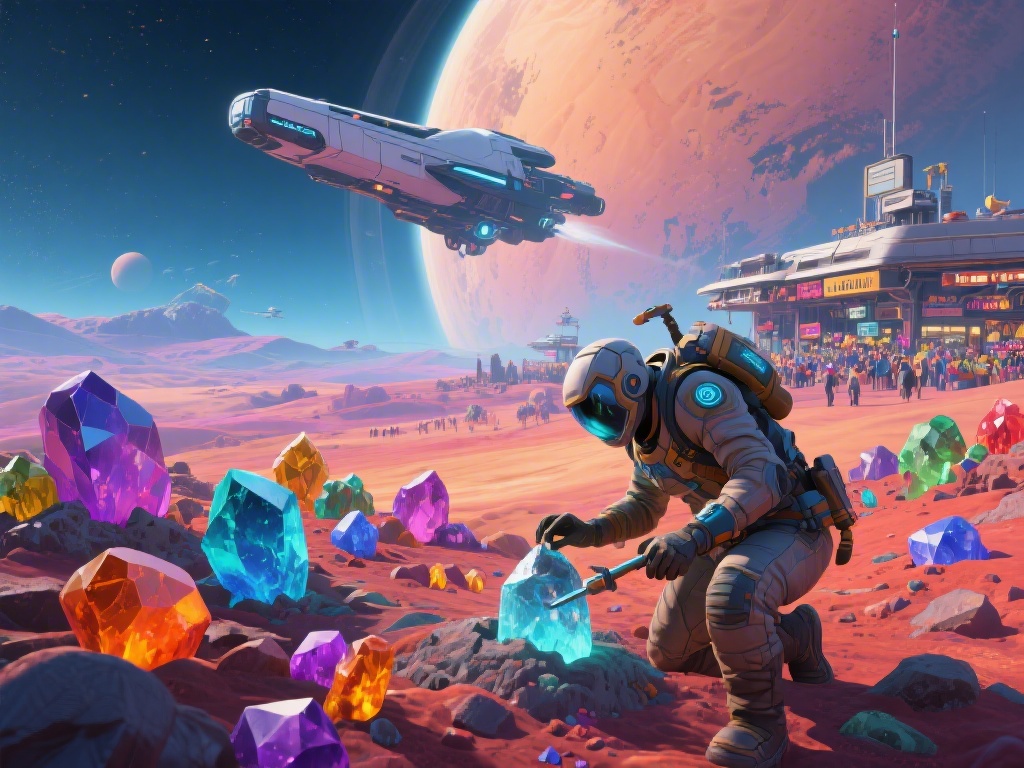
If you’ve ever sat staring at your No Man's Sky galaxy map, scrolling through endless glowing dots and wondering just how far you could travel, you’ve probably asked how many star systems are in No Man's Sky at least once. I’ve spent over 300 hours wandering the game’s universe, and I still stumble on new, wild systems every few sessions that make me forget my original travel goal. The scale of the game is almost hard to wrap your head around, especially if you’re a new player who just finished the opening tutorial and realized you can fly anywhere without loading screens. We’re breaking down exactly how big the game’s universe is, how it’s built, and what that means for your exploration runs.
How Many Star Systems Are in No Man's Sky, Exactly?
The short answer is a number so big it sounds made up, but it’s confirmed directly by Hello Games, the studio behind the title. The official total count of unique star systems in No Man's Sky is 18 quintillion, or 18,446,744,073,709,551,616 to be exact. That number isn’t random either — it’s the maximum number of unique outputs possible with a 64-bit procedural generation seed, which the game uses to build every part of its universe on demand.
You don’t have to be a math whiz to grasp how big that is. If you visited one new star system every second without stopping, it would take you more than 580 billion years to see every single one. That’s nearly 42 times the age of our real-life universe. Even with millions of active players exploring the game since its 2016 launch, the vast majority of systems have never been seen by any human player. Even with millions of active players since 2016, less than 0.001% of all star systems have been discovered by the community.
That means you could play every single day for the rest of your life, and you’d still never run out of new systems to explore. You’re almost guaranteed to find at least a handful of completely undiscovered systems on your first few dozen hyperdrive jumps, especially if you wander far from the popular starting galaxy regions.
How No Man's Sky Procedurally Generates Star Systems
None of this massive scale would work if the game had to pre-build every star system and store it on a server. Instead, every system is generated the second you first warp to it, using its unique 64-bit seed as a blueprint. The seed dictates every single detail of the system, from the color of its star to the type of alien life that lives on its planets. The generation is so consistent that if you share a system’s coordinates with a friend on a completely different platform, they’ll land in the exact same system you visited, with all the same planets and resources.
Every star system you visit will have a unique mix of features, including:
- Number and type of planets and moons, from frozen dead worlds to lush tropical biomes with extreme weather
- Resource distribution, including rare materials like Activated Indium or Storm Crystals that you can sell for huge profits
- Alien race dominance, whether the system is controlled by the Gek, Korvax, Vy'keen, or unclaimed by any major faction
- Space station layout, merchant inventories, and available side missions from NPCs you meet while docked
- Unique fauna and flora species, many of which may never be recorded by any other player if you don't upload them
You don’t need an internet connection to generate new systems, either. The only time you need to be online is to upload your discoveries to the community server, so other players can see the names you give systems and planets. You don't have to worry about running out of new systems to explore, even if you play every day for decades. The procedural generation algorithm is designed to avoid repeating exact system layouts, even when you’re exploring the farthest edges of the galaxy.
Tips to Track Your Star System Exploration Progress
With so many systems to explore, it’s easy to lose track of where you’ve been, especially if you bounce between story missions and random exploration runs. The game has a few built-in tools to help you keep track of your progress, and a few simple habits can make the process even easier. First, check your Exploration tab in the suit menu regularly. It tracks how many systems you’ve visited, how many planets you’ve fully scanned, and how many unique species you’ve discovered, plus it ties into the game’s explorer rank milestone system.
If you’re working toward 100% exploration of a specific region, use the galaxy map’s filter feature to hide systems you’ve already visited. That way you can easily spot unvisited dots to warp to next. I keep a small notebook next to my desk with coordinates of my favorite systems, so I don’t lose track of them when I’m jumping around the galaxy chasing story missions. It saves me so much time when I need to restock on rare resources or show a friend a cool planet I found.
If you discover a system with a high economy rating and peaceful sentinels, mark it as a home base candidate for easy resource farming later. Systems with three-star economies have higher value trade goods and more frequent spawns of rare S-class ships, so they’re worth holding onto. You can also upload all your discoveries to the Galactic Atlas, the game’s public community map, so other players can find the cool systems you’ve found.
Common Myths About No Man's Sky Star Systems Debunked
After years of the game being out, a lot of misinformation has spread about how its star systems work. Let’s clear up the most common myths first. One of the biggest ones is that all star systems are basically the same. That couldn’t be further from the truth. Systems are sorted by star color: yellow, red, blue, and green, each with different planet types and resource rarities. You need specific hyperdrive upgrades to visit red, blue, and green systems, and they have far more valuable resources than the default yellow starter systems.
Another common myth is that you’ll eventually run into other players randomly while exploring. The universe is so big that the odds of that happening are basically zero, unless you intentionally join a friend’s session or head to a popular community landmark. I’ve played over 300 hours and have never run into a random stranger while exploring an unmarked system, and most long-time players report the same experience.
Green star systems are the rarest type, and you’ll need a Cadmium drive upgrade to even see them on your galaxy map. They’re the only systems that regularly spawn lush, zero-extreme-weather planets that make perfect home base spots, so they’re worth hunting for once you have the right upgrades. A final myth is that your discovered systems get deleted after a while if you stop playing. As long as you upload your discoveries to the server, they stay there permanently, for any future player to find.
At the end of the day, the exact count of how many star systems are in No Man's Sky is less important than the feeling of wonder you get when you jump into a system no one has ever seen before. Whether you're playing to 100% your exploration milestones, hunt for rare S-class ships, or just wander and take screenshots of weird alien worlds, the game's massive scale means you'll never run out of new things to find. I still get excited every time my hyperdrive charges up and I jump to a new system, because I never know if I'm going to find a lush paradise world, a hostile storm world full of rare resources, or a weird system with 10 orbiting moons. If you haven't tried wandering off the main story path to explore random systems, I highly recommend it — you might find something that makes you fall in love with the game all over again.