If you've ever booted up No Man's Sky for the first time, you've probably stared up at the endless starry sky and wondered how many planets are on No Man's Sky. I remember asking that exact question my first hour playing, right after I fixed my broken ship and took off for the first time. The game's marketing has always leaned into its massive, almost infinite scale, but it's easy to wonder if that's just hype or a real, tangible feature you can interact with. Over 200 hours of playtime later, I've dug into the math, dev interviews, and my own exploration to get a clear, no-fluff answer.
How Many Planets Are On No Man's Sky, Exactly?
Hello Games, the studio behind No Man's Sky, has confirmed the official total of unique, explorable planets in the base game is 18,446,744,073,709,551,616. That's not a random made-up number either, it's the maximum value of a 64-bit unsigned integer, which the game uses as a seed to generate every single star system and world. I once did a silly challenge where I tried to visit 100 planets in a single play session, and not a single one had the same creature lineup or terrain layout, even though a few shared the same desert biome.
You will never run out of new planets to visit, even if you played 24 hours a day for your entire life. Let's do the quick math to put that number in perspective: if you visited one planet per second, it would take you over 580 billion years to see every single one. That's more than 42 times the age of our actual real-life universe, which is only 13.8 billion years old. Most players don't realize that every single planet you land on has never been seen by another player in most cases, especially if you stray off the popular community paths near the galaxy's core.
The count hasn't changed with any of the major free updates Hello Games has released over the years. Updates add new features, biomes, and assets that can appear on existing planets, but they don't increase the total number of possible seeds, so the total planet count stays fixed at that huge 64-bit number. Mods also don't add more planets, they just change how existing generated planets look or behave.
How No Man's Sky Generates All Those Unique Planets
All those planets aren't pre-built by developers, that would be physically impossible for a team of even 100 people to make in a thousand years. Instead, the game uses procedural generation to create every planet, creature, plant, and terrain feature on the fly as you approach a star system. The seed number tied to each system pulls from a library of pre-made assets, mixes them together with random variations, and spits out a fully functional planet with its own weather, ecosystem, and resource pools.
- Atmosphere type and weather patterns, from gentle rain showers to toxic acid storms that can melt your exosuit in minutes if you don't have proper protection
- Terrain shapes, including rolling plains, jagged mountain ranges, deep ocean trenches, and floating rock formations held aloft by natural magnetic fields
- Flora and fauna, with unique creature designs that can range from tiny, friendly rabbit-like aliens to giant, aggressive predators that hunt you across the surface for miles
- Resource spawns, which determine if a planet is a great spot to farm rare materials like activated indium or just a barren rock with nothing useful to offer for building or crafting
You don't need an internet connection to generate these planets either, the algorithm runs entirely locally on your console or PC. The only time you'll see another player's changes is if you land on a planet someone has already built a base on, or if you join a multiplayer session with friends. I once spent three hours exploring an ocean planet full of bioluminescent fish and floating coral forests, and later found out no other player had ever uploaded a discovery of that world to the community server. That's the magic of the system, you're constantly stumbling on things no one else has ever seen.
Common Myths About No Man's Sky's Planet Count Debunked
There are a lot of wrong claims floating around about the game's planet count, so let's clear up the most frequent ones. First, a lot of people say the number of planets is just a marketing gimmick and most of them are identical. That's not true at all. While you will find similar biome types across multiple planets, no two planets have the exact same mix of terrain, creatures, and resources. I've found two frozen planets in the same star system that were completely different: one had constant blizzards and giant ice worms that would attack if I got too close to their burrows, the other had clear skies and herds of gentle furry herbivores wandering the ice plains.
Another myth is that modded versions of the game add more planets, but that's not how it works. Mods can change what the planets look like, add new biomes or creatures, or adjust resource spawn rates, but they don't increase the total number of possible seeds, so the total planet count stays the same. The only time the feel of planets changed drastically was in the 2022 Frontiers update, which added new settlement and building variations to existing planet seeds, but didn't add new planets to the total pool.
The last common myth is that you can "beat" the game by visiting all planets, which is physically impossible, as we covered earlier. The game doesn't even track how many planets you've visited relative to the total count, because it's such a tiny fraction it doesn't matter. The game's core loop is built around exploration and discovery for its own sake, not checking off a list of every possible world.
Tips For Exploring Unique Planets Without Wasting Time
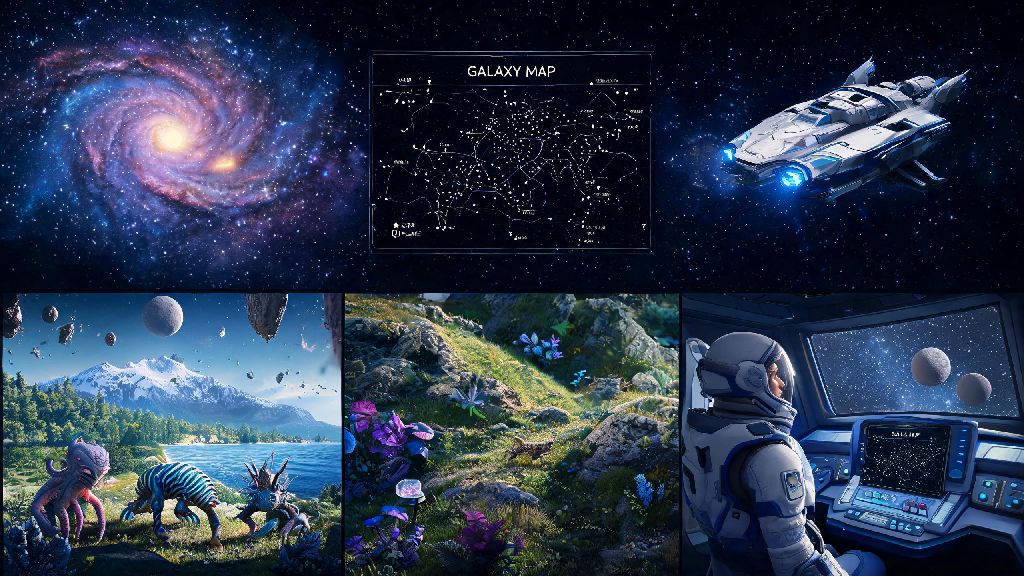
Now that you know how massive the galaxy is, you probably want to make the most of your exploration time instead of landing on 10 boring barren planets in a row. I've picked up a lot of tricks over hundreds of hours of exploring that help me find cool, unique worlds fast. First, always scan star systems from your galaxy map before you warp to them. The system's description will tell you what types of biomes are present, so you can skip systems that are full of dead, airless rocks if you're looking for lush, tropical worlds with friendly fauna.
Invest in a high-level scanner upgrade for your exosuit as early as possible. This will let you see all the resources, points of interest, and rare creatures on a planet as soon as you land, so you don't have to wander around aimlessly for hours looking for something cool. You can buy these upgrades from space station vendors, or craft them yourself once you unlock the right blueprints from the anomaly.
Another great tip is to follow community discovery markers if you're looking for truly wild, one-of-a-kind planets. Players often upload discoveries of worlds with weird quirks, like planets with two suns, or planets where it rains diamonds, or even planets where the entire surface is made of glass. Just don't be afraid to stray off the beaten path either. Some of my favorite planets I've found were in completely unmarked star systems that no other player had ever visited, on the very edge of the galaxy.
If you find a planet you love, make sure to upload your discovery and build a small base marker so you can come back to it later. It's easy to lose track of a great world when you're jumping between dozens of star systems a week, and having a permanent marker means you can bring friends back to show off your find whenever you want.
At the end of the day, the exact number answer to how many planets are on No Man's Sky is less important than what that number means for your play experience. It means you never have to run out of new things to see, new creatures to discover, or new resources to farm, no matter how many hundreds of hours you put into the game. You don't have to rush to see everything, because there's more than enough for multiple lifetimes of play. Whether you're a casual player who logs on for an hour a week to explore, or a hardcore player who spends days building massive bases on far-flung worlds, that massive pool of planets gives you all the freedom you could ask for to play the way you want. Next time you boot up the game, pick a random star system on the edge of the galaxy and warp to it. Chances are, you'll be the first person in the world to ever step foot on whatever planet you land on. That's pretty special.