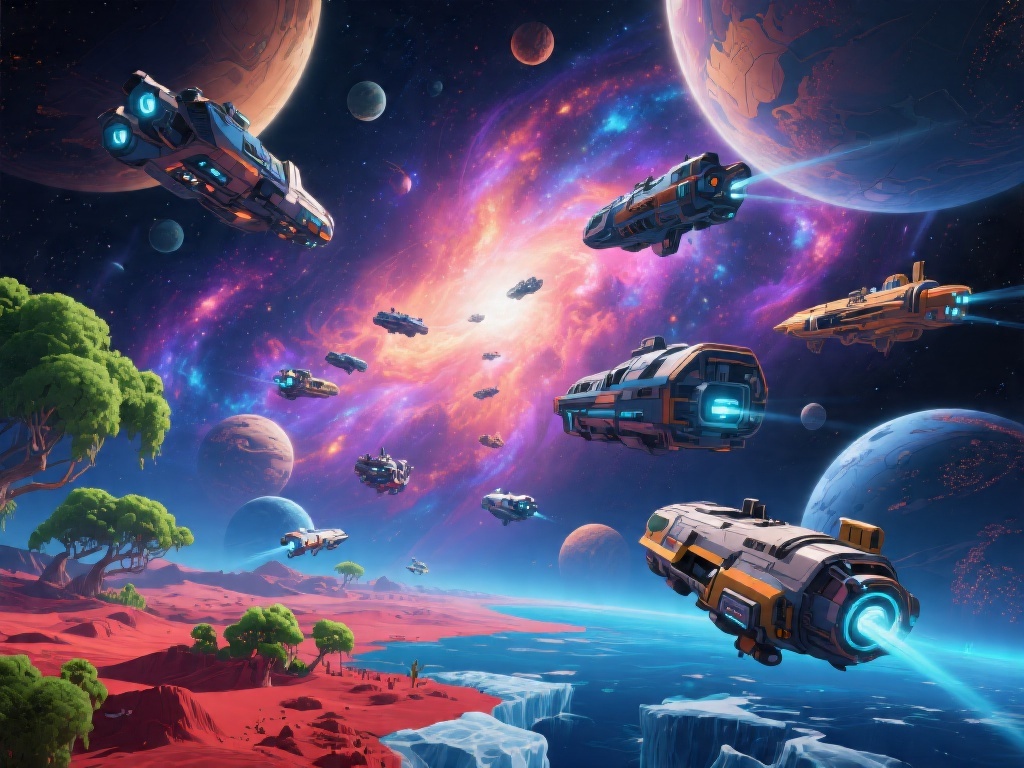
If you’ve ever warped to your first uncharted star system in No Man’s Sky and stared at the endless scroll of galaxy markers on your map, you’ve almost certainly asked how large is No Man’s Sky. I remember spending my first 10 hours of playtime stuck on my starting planet, convinced the entire game was just a handful of nearby systems I could clear in a week. It wasn’t until I accidentally warped 300 light years off course that I realized I’d barely scratched the surface of what the game has to offer. This guide breaks down exactly how big the universe is, how it’s built, and what that means for your playthrough.
How Procedural Generation Creates No Man’s Sky’s Near-Infinite Size
Unlike most open-world games that handcraft every inch of their maps, No Man’s Sky uses a proprietary deterministic algorithm to generate every planet, star system, and galaxy on demand when a player visits. That means Hello Games never had to store 18 quintillion planet files on servers — they only stored the formula to create them, which keeps the game’s file size under 15 GB even with years of post-launch updates. If you’re still wondering how large is No Man’s Sky compared to other open world games, it’s not even a fair comparison — most open world games are smaller than a single medium-sized No Man’s Sky planet.
The deterministic generation algorithm is key to the game’s consistent size, too. If two players input the same set of glyph coordinates, they’ll land on the exact same planet, with the same flora, fauna, terrain, and weather, even if neither has ever visited that location before. The only limit to the universe’s size is the 64-bit seed used to generate content, which caps out at 18 quintillion possible unique planets across all galaxies.
How Large Is No Man’s Sky, Exactly? Breaking Down the Math
The 18 quintillion planet number is thrown around a lot, but it’s hard to wrap your head around just how big that is. To put it in perspective, there are only an estimated 100 billion stars in our real-life Milky Way galaxy — that means No Man’s Sky has 180 million times more planets than our galaxy has stars. The game’s universe is split into 256 distinct galaxies, starting with the default Euclid galaxy that all new players spawn into. You can unlock travel to other galaxies by reaching the center of your current galaxy or using rare portal glyphs found across planets.
Each galaxy has roughly 4 billion unique star systems, and each system has between 1 and 6 planets plus orbiting moons. The distance from the edge of the Euclid galaxy to its core is roughly 700,000 light years, which would take hundreds of hours to traverse with a basic, unupgraded ship. There are a lot of common myths about the game’s size that are worth clearing up:
- Misconception: All empty space between planets is filler you can skip. You can actually fly between planets in real time without warping, though it can take hours of real time for distant planets in the same system.
- Misconception: The game shrank after early updates. All core planet generation rules are unchanged, only new content like settlements and derelict freighters was added to existing planet templates.
- Misconception: You can “beat” the game by exploring every area. Even if you visited one planet per second, it would take you over 585 billion years to see every possible planet in the game.
How Long Would It Actually Take to Explore Every Part of No Man’s Sky?
Most players never stop being surprised by how large is No Man’s Sky, even after hundreds of hours of play. If your only goal is to visit all 256 galaxies, that’s actually achievable with enough grind. With fully upgraded warp drives and glyph shortcuts, you can reach a new galaxy every 2 to 3 hours of play, so you could hit all 256 in less than 700 hours total. That’s a lot of time, but it’s doable for dedicated players.
Fully exploring a single planet is a totally different story, though. Most average-sized No Man’s Sky planets have a circumference roughly equal to Earth’s moon, so walking all the way around one would take 20 to 30 hours of real time, depending on terrain obstacles like mountains and oceans. If you want to scan every species of flora and fauna, collect all mineral types, find every buried site, settlement, and crashed ship on a single planet, that can add another 10 to 15 hours per planet. I have 1200 hours logged on my main save, and I’ve only fully explored 17 planets across 3 galaxies so far. As of 2024, less than 1% of all possible No Man’s Sky planets have been visited by any player, even with millions of active accounts worldwide.
Practical Tips for Exploring No Man’s Sky’s Vast Universe Without Overwhelm
Since you already know how large is No Man’s Sky, you don’t have to pressure yourself to see every single thing the game has to offer. The best part of the game is that you can play it at your own pace, no matter what your play style is. The first tip I always give new players is to set small, specific exploration goals instead of trying to “finish” the game. For example, you could set a goal to find all exotic planets in your current region, or collect all fauna on one planet per week, or find a perfect quiet ocean planet to build your main base on.
Next, make sure you save your favorite coordinates any time you find a location you love. The universe is so big that you will never stumble on that same spot again by accident if you leave and don’t save the glyphs. You should also invest in warp drive and launch thruster upgrades as early as possible, so you can travel longer distances without stopping to refuel every few jumps. If you get bored of exploring uncharted systems, you can use community-shared glyph coordinates to jump directly to cool spots other players have found, like rare exotic ship spawns, giant sandworm planets, or abandoned freighters full of loot. You don’t have to do all the work of finding cool spots yourself if you don’t want to.
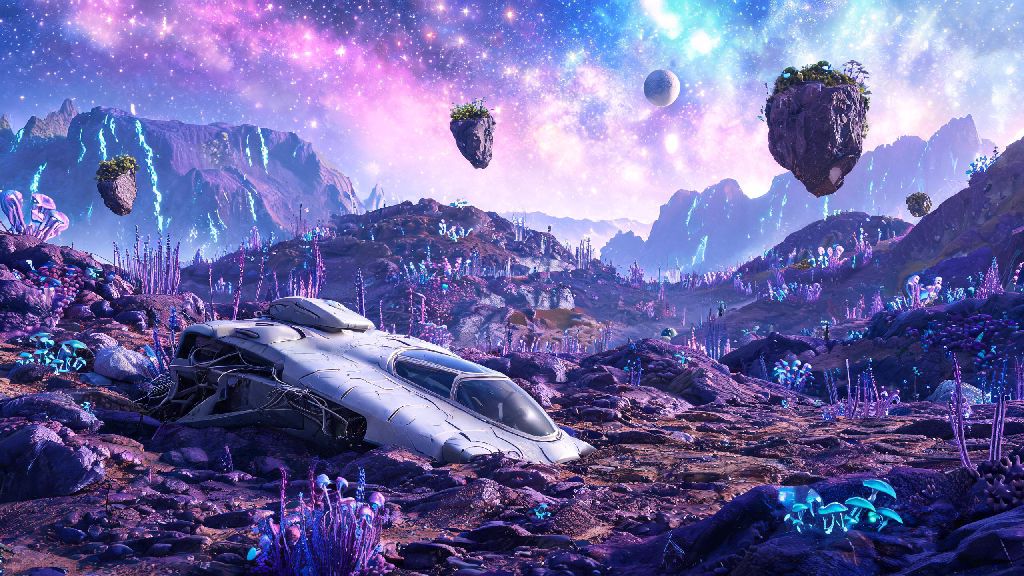
At the end of the day, asking how large is No Man’s Sky misses part of the point of the game — it’s designed to feel endless, so you can play it exactly the way you want to. Whether you want to spend 100 hours building a single base on a quiet, low-storm planet, or 10,000 hours hopping between galaxies looking for rare multi-tools and ships, there’s more than enough content to keep you occupied for years. You don’t have to rush to see everything, either. Half the fun of the game is stumbling on a weird, unexpected planet covered in rainbow flora and floating mountains when you least expect it, and that magic never fades no matter how long you play.